
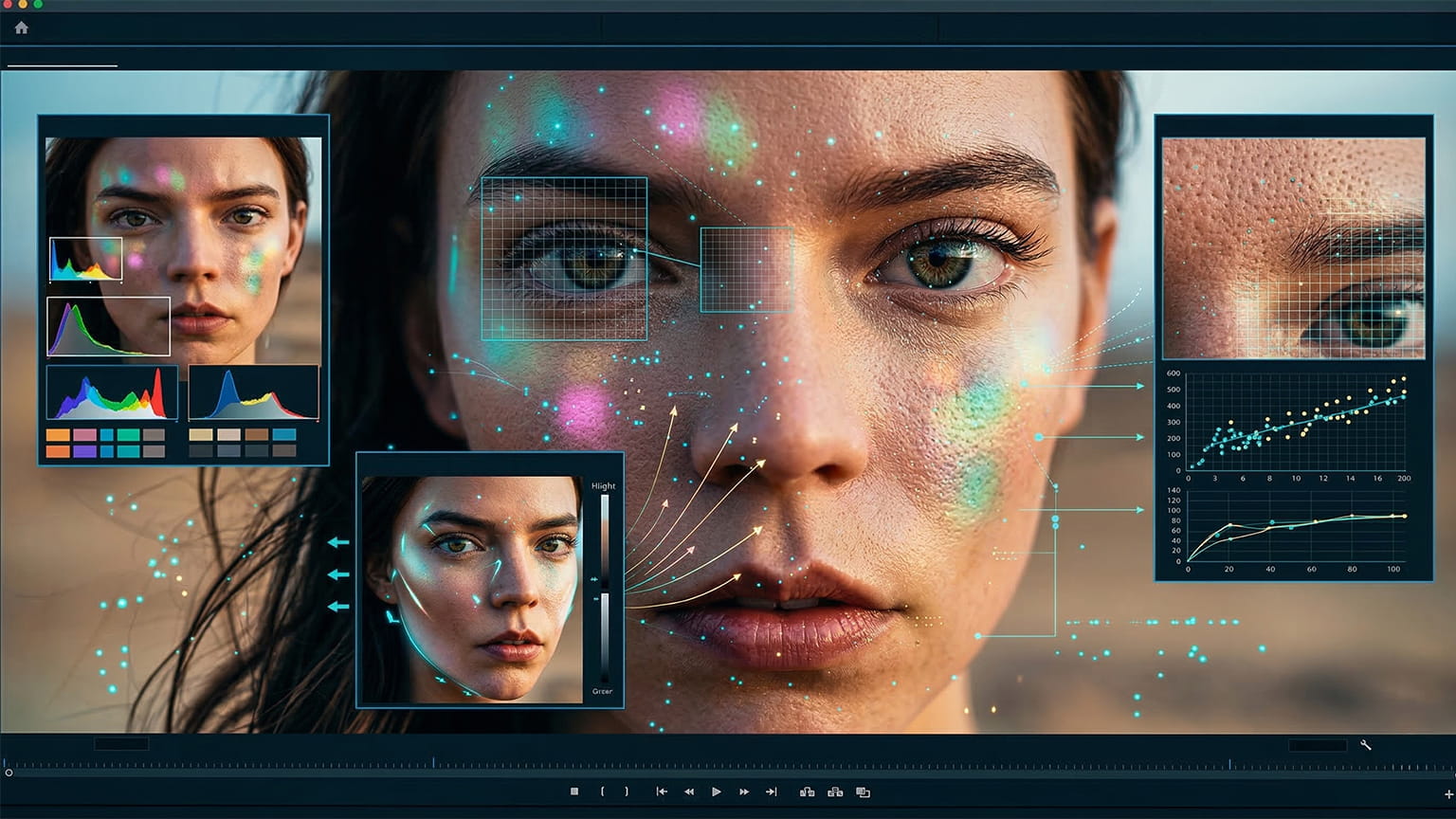
Imagine a film editor sitting in a dark room, surrounded by empty coffee cups and hundreds of hours of raw footage. Historically, the process of finding one specific perfect take was akin to searching for a needle in a haystack, only the haystack is digital, and the needle is a three-second clip of an actor blinking at the right moment. The romantic image of the “Director’s Cut” often masks the grueling reality of technical labor that precedes it. However, a quiet revolution is taking place in the editing suite. By incorporating artificial intelligence into the traditional assembly line, the industry is discovering that it can move faster without sacrificing the soul of the story.
What Is AI-Enhanced Post-Production?
AI-enhanced post-production refers to the integration of machine learning and algorithmic tools into the video editing services and finishing process. It is not an attempt to replace the human eye, but rather a method of automating the repetitive and technically demanding tasks that traditionally consume the majority of an editor’s schedule. These tools can perform functions such as identifying specific faces in thousands of clips, balancing color across different lighting conditions, and isolating clean dialogue from a noisy city street.
The primary objective is to streamline the transition from raw data to a finished product. By utilizing an AI filmmaking workflow, production houses can bypass the “grunt work” of organization and technical correction. This allows the creative team to reach the storytelling stage—the true Director’s Cut—much earlier in the timeline.
Why AI Is Transforming Video Editing Workflows
The demand for high-quality video content has grown exponentially, yet the human capacity to edit that content remains limited by time and fatigue. Traditional workflows often involve weeks of “logging” footage where an assistant editor manually watches every second of film to label scenes. This is where the AI video editing workflow creates the most significant impact.
In a traditional environment, the creative process is often delayed by these logistical bottlenecks. When an editor spends eight hours a day merely syncing audio to video, their creative energy for the actual cut is diminished. Artificial intelligence treats these logistical tasks as computational problems to be solved in seconds. This transformation shifts the role of the editor from a manual laborer to a high-level creative supervisor. The technology serves as a highly efficient assistant that handles the chores, leaving the final artistic decisions to the human professional.
Key AI Technologies Used in Post-Production
To understand the breadth of this shift, one must look at the specific technologies currently reshaping the industry. These are not futuristic concepts but practical tools used in modern AI film editing technology.
Automated Scene Detection
One of the most tedious parts of post-production is “breaking down” a long file into individual shots. Automated scene detection uses algorithms to recognize visual shifts, such as cuts or wipes, and automatically divides a single continuous file into separate, manageable clips. This eliminates the need for manual slicing and allows the editor to begin arranging the story immediately.
AI-Assisted Rough Cuts
The “rough cut” is the first draft of a film. Some AI video editing tools can now analyze a script and match footage to assemble a basic sequence based on dialogue and action. While this initial edit is rarely the final version, it provides a functional starting point. It allows the director to see the flow of the scene and make adjustments to the pacing without starting from a blank timeline.
Smart Color Correction and Grading
Consistency is the hallmark of professional video. If one shot is slightly warmer than the next, the audience feels a subconscious sense of amateurism. Smart color correction uses machine learning to analyze the “hero shot” of a scene and apply those identical color values to every other clip in that sequence. This ensures a uniform aesthetic across the entire project with minimal manual adjustment.
AI Audio Cleanup
Clear dialogue is often more important than crisp visuals. In the past, removing background hum or wind noise required expensive, specialized equipment and hours of surgical frequency editing. Modern AI audio cleanup can distinguish between the human voice and ambient noise, effectively “erling” the speaker’s voice while suppressing unwanted sounds. This technology has saved countless takes that would have previously been unusable.
Automated Subtitles and Transcriptions
With the global nature of modern media, accessibility is a requirement. AI can transcribe dialogue with remarkable accuracy in real-time. This not only assists in creating subtitles for different languages but also allows editors to search for specific words within the footage. Instead of scrubbing through a timeline to find a specific quote, an editor can simply type the word, and the software jumps to the exact frame.
How AI Reduces Editing Time Without Losing Creative Quality
A common concern in the arts is that automation leads to a loss of character. However, in video editing, the “character” comes from the choice of when to cut, how long to linger on a close-up, and the rhythm of the sequence. AI does not make these subjective choices. Instead, it provides a faster video editing process by clearing the technical obstacles that stand in the way and providing the best manual video production services UAE those choices.
For example, if an editor wants to experiment with three different versions of a scene, the time-consuming part is not the decision itself, but the physical act of moving clips, re-syncing audio, and re-grading the colors for each version. By automating these sub-tasks, AI allows the editor to “audition” multiple creative ideas in the time it used to take to create one. In this sense, technology actually enhances quality by giving the creator more time to iterate and refine their vision.
Benefits of AI-Driven Video Post-Production
The move toward an automated video post-production environment offers several tangible advantages for studios and independent creators alike.
- Efficiency: Projects that once took months can now be delivered in weeks. This allows production companies to handle a higher volume of work without increasing their headcount.
- Cost Reduction: By reducing the number of hours spent on manual tasks, the overall budget for post-production decreases. This makes high-end cinematic quality accessible to smaller businesses and independent filmmakers.
- Consistency: Algorithms do not get tired. They will apply the same level of precision to the last frame of a film as they did to the first, ensuring that the technical quality does not dip toward the end of a long project.
- Archivability: AI can tag footage with metadata, making it easier for companies to repurpose their media libraries years later
The Future of AI in Film and Video Editing
Looking ahead, the relationship between the editor and the machine will likely become even more collaborative. We may see systems that can suggest different editing styles based on the genre of the film or tools that can digitally alter an actor’s performance to match a new line of dialogue.
However, the “Director’s Cut” will always remain a human milestone. Filmmaking is an exercise in empathy and human connection—qualities that code cannot replicate. The future of the industry lies in a hybrid model where the machine provides the speed and the human provides the soul. As these tools become more sophisticated, the barrier between an idea and a finished film will continue to shrink, leading to a new era of prolific storytelling.
Conclusion: Balancing Technology and Creative Direction
The integration of AI-enhanced post-production is not a threat to the craft of filmmaking. It is an evolution of the toolset. Just as the move from physical film splicing to digital NLE (Non-Linear Editing) systems in the 1990s revolutionized the industry, AI is the next logical step.
By embracing these advancements, we are able to cut delivery times significantly. More importantly, we do so while keeping the creative integrity of the “Director’s Cut” intact. The goal is to spend less time fighting with software and How Brand Identity Design Impacts Customer Trust more time crafting the stories that resonate with audiences. In the end, the audience does not care if an algorithm helped balance the colors; they care about the emotion of the scene. AI simply helps us get that emotion to the screen a little bit faster.
FAQ’s
Q1. How is AI used in video post-production?
AI is used to handle repetitive technical tasks such as organizing raw footage through scene detection, cleaning up audio interference, matching color grades across clips, and generating instant transcriptions for subtitles.
Q2. Can AI replace video editors?
No. While AI can automate the technical “how” of editing, it cannot understand the “why.” Human editors are required to make decisions regarding pacing, emotional impact, and narrative structure, which are subjective and cultural in nature.
Q3. What are the benefits of AI in film editing?
The primary benefits include a significant reduction in production costs, faster delivery times for clients, and the elimination of human error in technical tasks like color matching and audio leveling.
Q4. Does AI improve video editing speed?
Yes. By automating the foundational steps of a rough cut and handling metadata tagging, AI allows editors to complete the assembly phase of a project much faster than traditional manual methods.
Q5. What AI tools are used in post-production?
Editors utilize various specialized software for functions such as “Generative Fill” to fix backgrounds, automated dialogue replacement (ADR) tools, and neural engines within popular editing suites that handle facial recognition and smart masking.
Deprecated: File Theme without comments.php is deprecated since version 3.0.0 with no alternative available. Please include a comments.php template in your theme. in /home/mysticstudio/public_html/wp-includes/functions.php on line 6260